
As Iraq’s long-running debate over placing all weapons under state control enters a more critical phase, tensions between the Iraqi government and Iran-aligned militias have intensified.[1] Several of the most powerful armed groups continue to resist surrendering their weapons, with the September 30, 2026, deadline for resolving the issue of uncontrolled arms approaching. Against this backdrop, Iranian Parliament Speaker Mohammad Bagher Ghalibaf made a three-day visit to Iraq, as prominent Shiite leaders seek a compromise capable of preventing the dispute from escalating into a potentially catastrophic confrontation.
The visit represents an important test of whether Baghdad can turn its commitment to a state monopoly on weapons into concrete measures capable of reshaping the country’s security landscape and redefining the relationship between state institutions and armed groups.
Tensions escalated following a recent wave of militia attacks targeting neighboring Gulf states and intensified further after the visit of the commander of Iran’s IRGC-affiliated Quds Force to Iraq. Reports suggested that his mission was aimed, at least in part, at reinforcing militia resistance to disarmament, reflecting the importance of militias in Iran’s regional strategy.
Given the foregoing, Ghalibaf’s visit raises several questions: Did it alter the political dynamics surrounding weapons control? How are the key parties responding to the Iraqi government’s insistence on ending the duality of authority and decision-making? And what are the prospects for establishing a genuine state monopoly on weapons as Iraq and the wider Middle East navigate an increasingly uncertain and volatile regional environment?
Ghalibaf’s Visit and the Unfavorable Environment Facing Iranian Clout in Iraq
Ghalibaf’s visit occurred as Iran’s influence in Iraq faces mounting pressure from both inside and outside the country. Externally, Washington is pressing Baghdad to reduce its dependence on Tehran, viewing Iraq as the next major arena in a broader effort to roll back Iran’s influence after its setbacks in Syria and the weakening of its position in Lebanon.
Inside Iraq, meanwhile, the Iraqi government has moved beyond merely reaffirming its commitment to its ministerial program. Article 9 explicitly calls for “ending the phenomenon of uncontrolled weapons outside the framework of official state institutions.” Baghdad has increasingly sought to translate this commitment into practical measures aimed at consolidating the state’s authority over both weapons and national decision-making.
The Iraqi government’s position is established on a clear principle: decisions of war and peace, as well as the possession and use of weapons, must remain exclusively Iraqi and subject to state authority. It has also emphasized preventing Iraqi territory from being used for military or political purposes outside the country’s constitutional framework.
These developments have created a more challenging environment for Iran-aligned armed groups and raise the stakes surrounding Ghalibaf’s visit, as Baghdad seeks to assert state sovereignty while navigating competing pressures from Iran, the United States and powerful domestic actors.
Setting a Timeframe to Transfer Arms to State Control
Iraqi Prime Minister Ali al-Zaidi has pledged to press ahead with efforts to curb the proliferation of weapons outside state control, declaring his readiness to pursue the issue at the risk of his own life. He has set September 30, 2026 as a final deadline for completing the process, signaling that Baghdad intends to move from political declarations to concrete enforcement measures. Most significantly, Zaidi has warned that armed activities conducted outside official state institutions after the deadline could be classified as terrorist acts and prosecuted under Iraq’s counterterrorism law. He has also ordered the preparation of legislation establishing a legal framework for restricting weapons possession to the state and ensuring that arms remain subject to constitutional authority.
Reshuffling Positions of Iraqi Security Leaders
Zaidi has also undertaken a sweeping reshuffle of senior military and security positions, removing officials associated with Shiite political parties and factions and those linked to influential figures within the Coordination Framework. He has replaced them with figures seen as more likely to consolidate security and military decision-making under the authority of the commander-in-chief, thereby strengthening the state’s monopoly over the use of force. Among the most significant moves was the appointment of former Interior Minister Lieutenant General Abdul Amir al-Shammari to head and reactivate the Office of the Commander-in-Chief of the Armed Forces. Zaidi also removed Abu Ali al-Basri as head of the National Security Service, replacing him with Basim al-Badri. Lieutenant General Karim al-Tamimi was dismissed as head of the Counter-Terrorism Service and replaced by Lieutenant General Zaid Hawshi, the former head of Military Intelligence. Lieutenant General Muhammad Qasim al-Fahd was appointed to lead the Federal Police. The reshuffle has generated unease among some Coordination Framework leaders, who fear that Zaidi is positioning the government for a direct confrontation with militias.
Arrests and Tightening the Noose Around Militias
Two developments offer important indications of the Iraqi government’s determination to test its ability to enforce state decisions while gauging the risks of escalating tensions with militias that have previously targeted state-linked figures and interests when their influence has been perceived to be under threat.
The first was the arrest by Iraqi security forces of Abbas al-Yaqoubi, a Popular Mobilization Forces (PMF) commander and intelligence chief for the Harakat Hezbollah al-Nujaba, based on information indicating an alleged plot to assassinate prominent Iraqi figures. Under militia pressure, authorities subsequently transferred him to PMF security forces. Reports then circulated that militias were prepared to revive the earlier scenario of encircling Baghdad’s Green Zone, interpreting the arrest as evidence that the confrontation had moved beyond political rhetoric to actual arrests.
Photo 1: Jurf al-Sakhr — a Longstanding Militia Stronghold
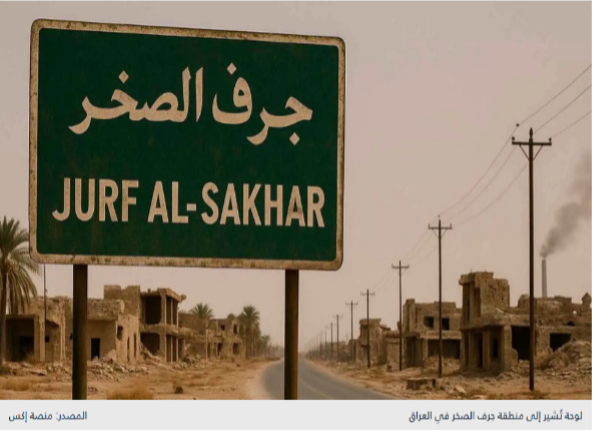
The second was the imposition of security cordons around two of the most sensitive militia strongholds: Jurf al-Nadaf, controlled by Harakat Hezbollah al-Nujaba, and Jurf al-Sakhr, a stronghold of Kata’ib Hezbollah. Both areas have remained largely inaccessible to state officials since ISIS was expelled, reflecting the militias’ enduring control. Jurf al-Sakhr, which was devastated and emptied of its population during the ISIS conflict in the predominantly Sunni provinces about 12 years ago, was subsequently sealed off by militias. Reports describe it as a major militia stronghold and an advanced base for Iran’s Islamic Revolutionary Guard Corps (IRGC), housing weapons depots, military facilities, missile and drone production sites and training centers operated by the Quds Force.
Dimensions of Ghalibaf’s Visit and the Outstanding Issues in Iraq
Ghalibaf’s visit to Iraq carries significant strategic implications amid the growing complexities surrounding Baghdad’s efforts to place all weapons under state control. The visit conveys several important messages.
The Iraqi Issue as Part of the Arrangements to End the US-Iran War
Ghalibaf’s visit to Iraq was intended to convey a broader message: Iraq is a central arena in Tehran’s negotiations with Washington and must be incorporated into any arrangements for ending the war. The mission is consistent with Supreme Leader Mojtaba Khamenei’s reported strategy of revitalizing the “Axis of Resistance” and preserving its role in the regional order that may emerge after the conflict.
Ghalibaf traveled to Iraq not only as speaker of Iran’s Parliament but also as head of Tehran’s negotiating team in talks with the United States. Since the beginning of Mojtaba Khamenei’s tenure, he has increasingly been involved in issues where Iran’s political, military and security interests overlap, particularly matters involving the IRGC, its regional allies and negotiations over an eventual end to the war with Washington. His role therefore differs from that of Foreign Minister Abbas Araghchi, whose mandate is primarily focused on formal diplomatic channels.
As Iraq remains one of the most sensitive issues in US-Iran relations, Ghalibaf is viewed as a potentially important figure for managing tensions between Baghdad and Iran-aligned militias, containing escalation and preserving Tehran’s influence in Iraq. His visit is therefore particularly significant because it brings together the interests of the IRGC, the militias, the Iraqi government and the emerging arrangements for the postwar regional order.
An Iranian Plot to Regulate Rather Than Relinquish Weapons
Before meeting with Iraq’s four presidencies, Ghalibaf opened his visit with a press conference at the site where Qassem Soleimani and Abu Mahdi al-Muhandis were killed, declaring that “the resistance in Iraq is one of the pillars of the country’s strength.” The choice of venue and message underscored the importance Tehran continues to attach to Iraq’s armed groups as part of its regional strategy.
Against this backdrop, the visit appears designed to shift the debate between Baghdad and the militias from the question of whether they should disarm to how their weapons could be managed. The move followed IRGC Quds Force Commander Esmail Qaani’s unsuccessful attempt to persuade the Iraqi government to soften its position on the September 30 deadline and may represent a renewed Iranian effort to find a way through the crisis without provoking another confrontation in Iraq under the Trump administration.
Reports suggest that Ghalibaf arrived with Iranian proposals aimed at preventing a direct clash between the Iraqi government and the militias, including freezing or concealing heavy weapons or temporarily transferring significant quantities of arms to Iran pending a broader agreement on their future in Iraq.
Ghalibaf’s visit was therefore far more than a routine diplomatic mission. It conveyed a clear message of Iranian support for the militias and their continued alignment with Tehran. His honoring of the families of militia members killed in Saudi Arabia’s response to attacks launched from Iraq was likewise interpreted as an unmistakable expression of support for the militias’ repeated attacks on the Gulf states.
Keeping Weapons With Militias in Exchange for Letting Iraqi Oil Pass Through the Strait Of Hormuz
Alongside the question of weapons, the talks also addressed Iraq’s oil exports through the Strait of Hormuz. Iraqi officials pressed for exemptions allowing their oil shipments to continue, arguing that Iraq is among the countries most severely affected by the strait’s closure because of its previous dependence on the waterway. Oil Minister Bassem Khudair said Iraq’s exports, estimated at 3.5 million barrels per day, had fallen by 75% as a result of the closure.
Iran rejected Baghdad’s request, reportedly arguing that granting Iraq an exemption would open the door to similar demands from other countries. Yet the refusal may also have served a broader political purpose: pressuring Baghdad to ease its campaign against Iran-aligned militias. This interpretation acquired salience after reports emerged, following Ghalibaf’s departure, that Iran had authorized a number of Iraqi oil tankers to pass through the strait, amid signs that Iraqi factions were moving toward managing their weapons rather than fully surrendering them.
The talks also reportedly addressed roughly $15 billion in Iranian funds frozen in Iraq, largely generated through payments for Iranian electricity and gas. Tehran has an urgent need for access to these funds as its economy strains under the combined weight of war and sanctions, while Washington moves toward tightening Iran’s economic isolation.
Iran’s Militias and Attempts to Blow Up the Iraqi Arena
In response to the Iraqi government’s efforts to bring weapons under state control and pursue corruption cases against influential figures, Iran-aligned militias have adopted an increasingly confrontational posture toward Baghdad’s decisions. Their actions appear aimed at creating political and security instability, undermining the Iraqi government’s authority and obstructing its efforts to consolidate state control.
Assassination Plots Against Influential Judicial Figures
Intelligence reports have uncovered alleged militia plans to assassinate Faiq Zaidan, head of Iraq’s Supreme Judicial Council and the country’s highest-ranking judicial authority. The reported plot appears linked to Zaidan’s support for the Iraqi government’s efforts to place weapons under state control, combat corruption and pursue cases against individuals and organizations that had remained beyond effective accountability for years.
Militia leaders reportedly fear that the expanding anti-corruption campaign could expose senior commanders or threaten their broader networks of influence, including affiliated offices, businesses and commercial interests. Their concerns have intensified over Zaidan’s reported insistence that Article 4 of Iraq’s 2005 Counter-Terrorism Law be applied to anyone who refuses to surrender weapons by the September 30 deadline.
Such a move would carry particularly serious implications for the militias, as it could, for the first time, formally place armed groups rejecting state authority within the framework of terrorism offenses under Iraqi law. The reported assassination plot therefore appears intended not only to intimidate Zaidan but also to deter other officials involved in the Iraqi government’s campaign to establish a state monopoly on weapons.
The alleged effort is reportedly part of a broader campaign targeting figures seeking to advance weapons control, with Zaidan among its principal targets. It would also follow earlier reported attempts by militias to assassinate former Prime Minister Mustafa al-Kadhimi.
Targeting Official Headquarters in Kurdistan
Kurdistan Region Prime Minister Masrour Barzani said that two Iranian drones targeted his private office and the residence of the head of the region’s Parastin intelligence agency, marking a potentially significant escalation in Iran’s approach toward the Kurdistan Regional Government (KRG). Although Araghchi denied responsibility, the reported strikes have been interpreted as a possible preemptive warning to the KRG following its statements supporting efforts to place weapons under state control.
The attacks may also reflect Tehran’s concern over the KRG’s expanding relationship with Washington, particularly amid speculation that Barzani could play a mediating role in potential US-Iran negotiations. “Hardliner” elements within Iran’s leadership may be seeking to signal that closer cooperation with Washington could expose the KRG to direct Iranian pressure.
This concern is especially significant amid expectations that negotiations could fail and that any subsequent conflict might take a different form from previous rounds of tit-for-tat attacks. Iranian decision-makers may fear that Washington could seek to mobilize Kurdish forces inside and outside the region as part of a broader strategy against Tehran.
If confirmed, the strikes would represent a qualitative escalation, suggesting that Iran may increasingly target political decision-making centers and senior officials as part of its strategy. Such a shift could make neutrality increasingly difficult for regional governments, forcing them to reconsider the risks of distancing themselves from the conflict or cooperating with Washington.
Threats to Use Armed Force Against the Iraqi State
Militia rhetoric has increasingly shifted from political opposition to explicit threats of armed confrontation with the Iraqi state, particularly following Qaani’s visit to Baghdad, where he met with leaders of the PMF and other armed groups. According to reports, Qaani conveyed Tehran’s opposition to the immediate surrender of militia weapons, citing expectations of a possible new round of regional conflict. If accurate, the position would constitute further evidence of Iranian interference in an issue that Baghdad regards as a matter of national sovereignty.
Following Qaani’s visit, Harakat Hezbollah al-Nujaba, Kata’ib Hezbollah and Kata’ib Sayyid al-Shuhada intensified their attacks on Iraq’s commander-in-chief, despite the fact that some PMF brigades formally operate under his authority. The most serious escalation came from Kata’ib Hezbollah official Abu Mujahid al-Assaf, who threatened armed action if Zaidi proceeded with his weapons-control plan, warning that relations with the Iraqi government would follow an “eye for an eye” principle.
Assaf also outlined conditions for surrendering weapons, including:
- The complete withdrawal of US forces from Iraqi territory and airspace, with guarantees against their return, as well as what he described as freeing Iraq’s political and economic decision-making from US influence.
- The withdrawal of Turkish forces from northern Iraq.
- The dissolution of the Peshmerga, despite its status as a constitutionally recognized Iraqi security force.
These challenging demands reveal that, for militias, the weapons issue extends far beyond domestic security policy. They are linking disarmament to Iraq’s relationships with Washington and Ankara and to the broader regional balance of power. This significantly complicates efforts to reach an agreement with Baghdad before the September 30 deadline and suggests that the dispute could evolve from a question of state authority into a broader confrontation over Iraq’s strategic orientation.
Potential Outcomes and Scenarios of Bringing Arms Under State Control
Based on the developments outlined above, the Iraqi government’s campaign to bring all weapons under state control is likely to lead to three principal scenarios once the September 30 deadline for militias expires.
First Scenario: State Control Over Arms
This means the Iraqi government’s campaign must ultimately produce a tangible outcome: establishing effective state control over weapons. This could be achieved through a political agreement with the Coordination Framework, potentially offering militia leaders assurances against prosecution, political concessions, government positions or other guarantees. Alternatively, Baghdad could capitalize on favorable domestic and international conditions to undertake limited military action aimed at militia disarmament. The latter option, however, carries enormous risks, as any confrontation with fighters experienced in urban and street warfare could quickly develop into a catastrophic scenario.
Several factors could strengthen the government’s position:
- Broad popular support: Zaidi’s campaign against uncontrolled weapons and corruption enjoys significant support across Shiite, Sunni and Kurdish communities and provinces.
- Wide political backing: The Iraqi government’s efforts have received support from influential Shiite, Sunni and Kurdish forces, including the Shiite National Movement led by Muqtada al-Sadr, the Progress and Sovereignty alliances and the Kurdistan Democratic Party and Patriotic Union of Kurdistan.
- Religious backing: The religious establishment in Najaf has repeatedly called for the rule of law, a state monopoly on the use of force and an uncompromising fight against corruption. Such calls have reportedly been issued roughly 15 times between 2003 and 2025.
- Iran’s strategic predicament: Tehran faces continuing tensions with the United States and Israel, while the weakening of the “Axis of Resistance,” particularly following Syria’s removal from Iran’s regional project, has fundamentally altered the strategic environment along Iraq’s northern border.
- Growing US and Israeli pressure: Washington and Tel Aviv have intensified pressure and threats aimed at eliminating the Iran-backed militia threat in Iraq as part of a broader strategy to constrain Tehran’s regional influence and force it to accept a new regional deterrence framework.
Second Scenario: Arms Retention by Militias
Under this scenario, Zaidi’s campaign to bring all weapons under state control would ultimately fall short, reflecting the complexity of Iraq’s political and security landscape and the entrenched power of armed groups. Rather than meeting the September 30 deadline, the process could be delayed, diluted or circumvented. Several factors point in this direction:
- Growing opposition within the Coordination Framework: The framework has raised concerns over the government’s proposed guarantees, timetable and implementation mechanisms. Nouri al-Maliki, head of the State of Law Coalition, has called for postponing militia disarmament until after the US withdrawal, while the Badr Organization, led by Hadi al-Amiri, has categorically rejected the use of force to compel armed groups to surrender their weapons. A growing preference within the Coordination Framework for extensions, gradual implementation and political compromise appears to be outweighing support for risky coercive measures.
- Militia integration within the political system: Iraq’s militias are not simply armed groups operating outside politics; many are closely tied to parliamentary alliances and state institutions. Political forces aligned with them reportedly control roughly 80 parliamentary seats while exercising substantial security, economic and social influence. Any attempt to disarm them by force could therefore transform a security dispute into a political crisis threatening the Iraqi government’s own institutional base.
- Militia capacity for disruption: Their large numbers, sophisticated arsenals — including ballistic missiles and suicide drones — and presence across strategic locations and border crossings give them considerable capacity to destabilize the country. Their close ties to the PMF could also ensure broader support in the event of an internal confrontation.
- Iran’s geographic advantage: Iraq’s proximity to Iran gives Tehran a significant logistical advantage compared with its relationships with militias in Lebanon and Yemen. Iran can rapidly provide financial, military and logistical assistance while facilitating the movement of personnel across the border, helping preserve its influence.
- The regional dimension: Iraq’s militia question is closely connected to the future of Hezbollah’s weapons in Lebanon and to the changing strategic environment along Iraq’s northern frontier. Tehran may view concessions in Iraq as potentially creating pressure for similar concessions regarding Hezbollah, making it reluctant to accept a settlement in either arena.
- The shift from conflict resolution to conflict management: Major powers increasingly appear less capable of imposing definitive settlements on regional actors and more focused on managing interconnected conflicts. The overlap of competing interests across multiple countries, together with the growing weight of geopolitics, has produced a strategic environment in which containing conflicts may prove more realistic than resolving them outright.
Scenario Three: Lax Resolutions and Timeframe Extension
This appears to be the most likely scenario: Iraq’s political actors will pursue a gradual integration process designed to strengthen the state’s monopoly on the use of force without provoking a direct confrontation with militias. The approach would rely on dialogue and back-channel negotiations to reach workable compromises and prevent Iraq from sliding into a potentially catastrophic internal conflict.
Several developments support this assessment. The September 30 deadline appeared to lose momentum following Ghalibaf’s visit, after which Amiri, Ammar al-Hakim and Sudani stepped up efforts to broker an understanding between the Iraqi government and militias. The three presidencies also adopted a more conciliatory and diplomatic tone. On August 22, 2026, President Nizar Amidi acknowledged that some militias had fought ISIS and suffered casualties, while emphasizing that they should ultimately surrender their weapons and integrate into the state’s security institutions.
The Iraqi government has likewise softened its language regarding the use of force and the disarmament timetable. Zaidi denied plans for a military confrontation, while Parliament Speaker Haibat al-Halbousi said the disarmament process would begin after September, stressing that there would be no confrontation with militias. Iraqi government spokesman Haider al-Aboudi further stated that September 30 marks the withdrawal of US forces from Iraq, rather than a final deadline for militia disarmament. In practice, this could create additional time for negotiations and a political settlement.
Potential Arrangements Include
- Depositing or concealing weapons: Militias could place their weapons in storage under PMF or state supervision, as Asa’ib Ahl al-Haq and Saraya al-Salam have reportedly done, or conceal them from public and state oversight.
- Restricting heavy weapons: Heavy weapons could be withdrawn from operational use and stored in designated depots, while militias retain some medium and light weapons.
- Selective disarmament: Conventional weapons — including artillery, tanks and small arms — could be surrendered while Iranian-supplied drones and missiles remain outside the process.
- Political and institutional integration: Militias could be granted greater political participation, while some fighters are incorporated into official security structures or given regulated legal status in exchange for gradually abandoning independent military activity and accepting the state’s exclusive authority over the use of force.
- Creating a transition period: A gap could be established between the US withdrawal and the start of weapons registration, collection or management, providing time for negotiations and reciprocal guarantees.
- Gradual dismantling: The state could progressively weaken militia capabilities by disrupting supply routes, restricting transfers, tightening oversight of border crossings and ports and absorbing fighters into the Defense Ministry, police and civilian institutions. Others could be offered retirement, gradually reducing militias’ independent manpower and organizational capacity.
Conclusion
Recent developments following Ghalibaf’s visit suggest that the most likely course for Iraq’s political actors is de-escalation rather than confrontation. The debate is increasingly shifting from outright disarmament toward weapons management, within a gradual, long-term process aimed at reorganizing rather than immediately dismantling militias. Such an approach would seek to contain tensions and preserve enough political space for compromise to prevent an internal conflict, while stopping short of abandoning the principle that the state must retain a monopoly on weapons and the use of force. It could also allow Baghdad to demonstrate progress on weapons control under US pressure without pushing Zaidi toward resignation. Continued domestic and international pressure is likely to produce incremental measures restricting militia movements, tightening oversight of their funding and reinforcing the principle that any use of force must be authorized by the commander-in-chief of the armed forces. The issue, however, has increasingly acquired an international dimension, becoming part of the broader US-Iran confrontation. Tehran seeks to preserve a balance of armed power in Iraq, while Washington wants to weaken Iran’s regional proxy network before reaching any broader agreement with Tehran. The militias, meanwhile, understand that ignoring US pressure could eventually expose their positions to direct military action. Iran therefore appears intent on slowing or circumventing Baghdad’s weapons-control efforts while seeking an arrangement that preserves Iraq as a strategic lever in its regional policy. The surrender of militia weapons would run directly against the priorities of Iran’s emerging military leadership under Mojtaba Khamenei, which is seeking to revive and strengthen what Tehran calls the “Axis of Resistance.”
[1] Kata’ib Hezbollah, Harakat Hezbollah al-Nujaba and Kata’ib Sayyid al-Shuhada.
