

Introduction
Developments in Iraq point to a marked expansion in the influence of Asa’ib Ahl al-Haq (AAH), led by Qais al-Khazali, within the country’s political landscape following the assassination of Iranian Quds Force Commander Qassem Soleimani in 2020. The group’s growing reach is reflected in the diversification of its instruments of influence and the broadening of its footprint beyond the military sphere into political, economic, social and cultural domains. This evolution has elevated AAH into one of the most influential armed factions shaping Iraq’s decision-making process. Its expanding role has, in turn, fueled domestic and international concerns over a gradual and calculated penetration of state political, economic and cultural institutions, enabling the formation of a parallel or “deep state” under a pragmatic political guise. Such a strategy would enable the group to adapt to Iraq’s evolving political environment while advancing the interests of ideologically-aligned external actors. More broadly, this approach seeks to preserve the entrenched dominance of militia-driven governance in Iraq.
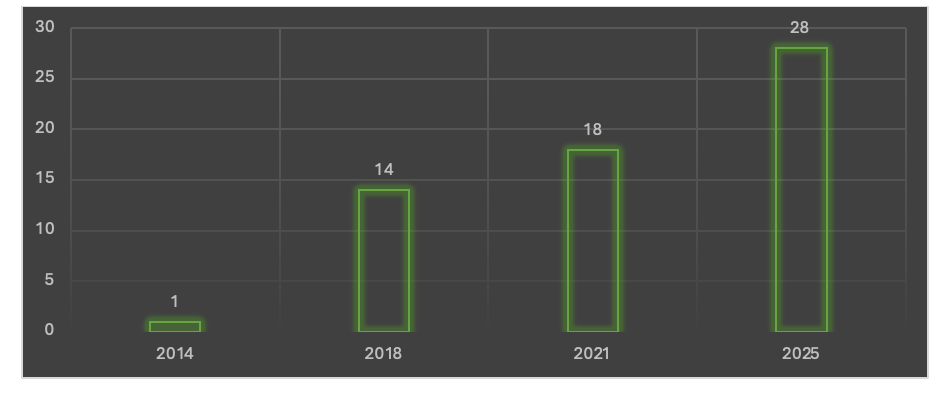
Within a decade, AAH has transformed into a major political force. Its parliamentary representation increased from a single seat in Iraq’s third parliamentary elections to 28 seats in the sixth, making it the largest individual electoral alliance, the second-largest Shiite alliance and the fourth-largest parliamentary bloc in the 2025-2029 legislature. For the first time, the group also secured the post of first deputy speaker of Parliament, underscoring its growing institutional influence. At the same time, it has increasingly promoted a narrative centered on consolidating its political role while transferring responsibility for weapons to the state. This reflects a broader effort to redefine the group as a political rather than a military faction, shifting its center of gravity from armed mobilization to institutional engagement. The strategic objective is not the abandonment of influence, but its consolidation through state structures, allowing the group to extend its reach to the highest levels of power through new mechanisms, institutional channels and political legitimacy.
The political ascent of AAH, particularly in comparison with other Iraqi militias, and its growing efforts to expand its influence through state institutions rather than exclusively through armed activity, raise several critical questions: Does its apparent shift from a military to a political strategy signal a genuine strategic realignment in favor of strengthening the Iraqi state, or does it represent a tactical adaptation designed to preserve and expand its influence through new instruments and institutional channels? What factors account for the group’s rapid political rise and what are the broader implications for Iraq’s political system? Why has AAH placed greater emphasis on its political identity than other armed factions? To what extent does its ideological framework shape the evolution of its methods and organizational posture as it seeks to consolidate power? How does the group position itself on key national issues, particularly the debate over establishing a civil state? More fundamentally, can non-state armed actors in Iraq successfully transition into conventional political actors without reverting to violence, and are they genuinely prepared to dismantle their military structures and relinquish their heavy weapons?
Ideological and Political Characterization of Khazali
A close examination of Khazali’s speeches,* political positions and conduct on major Iraqi issues suggests that he has evolved into one of the country’s most influential political figures, rising from the margins to the center of Iraq’s power structure.* According to many observers, Khazali is driven less by the ambitions of a religious or military leader than by a long-term political project aimed at capturing state power and constructing a parallel or “deep” state. His approach is characterized by a highly pragmatic and adaptive political style, marked by a willingness to adjust rapidly to shifting realities in pursuit of strategic objectives. Rather than adhering to rigid ideological formulas, he evaluates policies primarily through the lens of their practical outcomes.
This pragmatic approach helps explain his fluid shifts between military and political roles, adopting whichever posture best advances his strategic interests at any given moment. It also reflects a long-term strategy of gradually embedding his group’s influence within Iraq’s state institutions. At times, Khazali presents himself as a militia commander; at others, as a conventional political leader. In many instances, he combines both roles, integrating military leverage with political engagement as circumstances require. His flexible and adaptive strategy has been shaped by several interrelated factors, most notably:
Multiple Ideological Backgrounds
Khazali’s ideological background defies easy classification within any single Shiite religious establishment. In his public statements and political engagements, he has avoided declaring allegiance to a specific marja (Shiite religious authority), despite maintaining close relationships with influential clerical circles in both Najaf and Qom. This deliberate ambiguity appears to reflect political calculations rather than doctrinal uncertainty, underscoring a deeply pragmatic approach that affords him considerable flexibility to recalibrate his positions in pursuit of political objectives. In this respect, he differs from many militia leaders whose ideological orientations remain firmly anchored in Iran’s doctrine of Wilayat al-Faqih (Guardianship of the Islamic Jurist).
During his formative years, Khazali was profoundly influenced by the late Grand Ayatollah Muhammad Muhammad Sadiq al-Sadr,* largely because he grew up in Sadr City,* Baghdad, the densely populated district long regarded as the stronghold of the influential Sadr family. After completing his secular education and earning a bachelor’s degree in geology from the University of Baghdad, he enrolled in the Najaf seminary, where he studied under Sadr from 1994 until the cleric’s assassination in 1999. Khazali earned Sadr’s confidence through his commitment to religious scholarship, including his research into the scientific dimensions of Islamic rituals associated with sunrise and sunset.[i] As a result, Sadr entrusted him with a series of administrative and educational responsibilities, including assisting in the supervision of the Najaf seminary schools, managing affairs within his office and later serving in its Sharia Department.[ii] These roles elevated Khazali’s standing within Iraq’s Shiite community, particularly among followers of the Sadrist Movement.
Following the death of Muhammad Muhammad Sadiq al-Sadr, Khazali developed a close relationship with Iraq’s preeminent Shiite cleric Grand Ayatollah Ali al-Sistani. Like Sadr, Sistani rejects the doctrine of absolute or universal Wilayat al-Faqihas articulated by its principal Iranian proponents. Instead, he advocates a civil state in which the government holds the exclusive monopoly over the legitimate use of force.
Although Khazali has consistently declared his respect for and adherence to the guidance of the Najaf religious establishment, his political conduct has often diverged from its principles. This divergence is particularly evident in his approach to the role of the clergy in public life. Whereas the Najaf school traditionally favors a “quietist” model of religious authority — one that maintains institutional distance from partisan politics and preserves the separation between clerical leadership and political competition — Khazali’s outlook has more closely resembled that of Muhammad Muhammad Sadiq al-Sadr. His approach embraces an activist vision of the religious establishment, one that views political engagement and direct involvement in public affairs as essential to advancing reform and shaping society.
This tension has also been reflected in his position on the state’s monopoly over weapons. For years, Khazali resisted repeated calls from the Najaf religious establishment for armed factions to relinquish their weapons to the Iraqi state. It was not until May 2026 that he publicly agreed to do so, marking a significant shift in his longstanding position.
At the same time, Khazali has consistently affirmed his commitment to the doctrine ofWilayat al-Faqih, which holds that the supreme leader exercises ultimate religious and political authority over Shiite Muslims worldwide and serves as the representative of the Hidden Imam until his return, serving as a ruse for advancing Iran’s expansionist ambitions. This ideological orientation helps explain his adoption of the rhetoric associated with Iran’s “Axis of Resistance,” even as he continues to profess respect for the guidance and public directives of Sistani.[iii]
By drawing on multiple currents of Shiite political and religious thought, Khazali has cultivated a high degree of ideological and political flexibility. This approach has enabled him to maintain channels of communication with diverse Shiite political factions and religious authorities while adapting his public positioning and alliances to changing political circumstances. Such flexibility has enhanced his ability to advance his strategic objectives by recalibrating his affiliations and political posture in ways that best serve his long-term ambitions.
A Homegrown Group
Unlike many Iraqi militias that emerged primarily as Iran-backed organizations from their inception — such as Kata’ib Hezbollah, Harakat Hezbollah al-Nujaba and Kata’ib Sayyid al-Shuhada — AAH developed from a more localized Iraqi foundation. Between 2005 and 2006, a group of seminary students, including Khazali, his brother Laith al-Khazali and Akram al-Kaabi, established the Special Groups, which later became the organizational core of AAH.
The group initially operated within the broader framework of the Saraya al-Salam (the Mahdi Army), the armed group founded by Muqtada al-Sadr following the 2003 US-led invasion of Iraq to oppose the presence of US forces. However, the founders of the Special Groups soon broke away after Sadr announced in 2008 an indefinite suspension of military operations against US troops. They subsequently established AAH, which was formally announced as an independent group in 2011. The split appears to have been driven not only by ideological and strategic differences but also by Khazali’s personal ambitions. He believed that his role as Muqtada al-Sadr’s deputy was unlikely to provide him with lasting influence and that he was capable of leading an independent and powerful armed group of his own.
Some US media reports have suggested that Iran’s Quds Force and Lebanon’s Hezbollah played a role in supporting AAH’s split from Muqtada al-Sadr, primarily to preserve armed operations against US forces in Iraq.[iv] However, US documents containing statements attributed to Khazali during his detention, along with that of his brother Laith al-Khazali, in US custody between 2007 and 2009 indicate that he portrayed the split as being driven largely by financial disputes. According to these accounts, Khazali cited disagreements over the distribution of Iranian financial assistance among Muqtada al-Sadr’s inner circle as a key factor behind his departure from the movement.
In 2018, AAH was incorporated into Iraq’s Popular Mobilization Forces (PMF), a move that enabled the group to secure official salaries for its members and receive logistical support funded through the Iraqi state budget. This institutional integration marked a significant transformation, shifting AAH from an armed faction primarily engaged in fighting US forces into one of Iraq’s largest, most structured and politically influential militia organizations.
The group’s Iraqi origins also helped shape Khazali’s pragmatic approach and provided him with a greater degree of autonomy in strategic decision-making compared with militias whose foundations were established primarily through direct Iranian patronage and influence.
Developments in the Context of a Complex Iraqi Landscape
The complex trajectory of Iraq’s political and security environment after 2003 played a significant role in informing Khazali’s pragmatic approach, which increasingly combined armed activity with political engagement as a means of advancing his strategic objectives. One notable example was the prisoner exchange agreement with the United States that secured the release of Khazali and his brother after approximately three years of detention in Camp Cropper, a high-security US prison in Iraq. The two had been held on allegations of involvement in the 2007 Karbala attack, which resulted in the deaths of five US soldiers. In exchange, AAH released five British nationals whom the group had abducted in 2009.
Following the partial withdrawal of US forces from Iraq in 2011, the group’s reliance on armed operations gradually declined in comparison with the period of direct confrontation with US troops. Khazali subsequently shifted greater attention toward political mobilization, establishing the Sadiqun Movement to participate in Iraq’s 2014 parliamentary elections. Nevertheless, AAH’s armed capabilities remained active alongside its political activities, including operations targeting US interests, until the group formally transferred its weapons to the Iraqi state.
The third major development was the US-Iraqi agreement to end the mission of the US-led international coalition against ISIS in Iraq by September 2026. The fourth was the political vacuum created by Muqtada al-Sadr’s withdrawal from the political arena following his power struggle with former Prime Minister Nouri al-Maliki. The fifth involved the US opposition to granting ministerial portfolios to alliances affiliated with armed militias in Prime Minister Ali al-Zaidi’s government.
Thus, Khazali may be seeking to leverage acceptance of the state’s monopoly over weapons as a political strategy to gain access to ministerial positions and greater institutional influence, while preserving the option of returning to armed operations when circumstances require. A similar approach was evident in 2012, when he announced that AAH was prepared to surrender its weapons, while also indicating that the group would continue pursuing its objectives through political engagement alongside military operations.
The Context of AAH’s Political Rise
Khazali formally entered the political arena with the establishment of the Sadiqun Movement in 2014. The bloc achieved a rapid political ascent, expanding its parliamentary representation from a single seat in the 2014 elections to 28 seats in 2025 (see Figure 1). It also secured, for the first time, the position of first deputy speaker of Parliament, awarded to Adnan Faihan,[v] marking a significant milestone in its institutional influence.
Its growing weight has also been reflected in its role in the nomination of prime ministers, the allocation of ministerial portfolios and the determination of positions on key national issues.
Figure 1: AAH’s Legislative Ascent
Source: Center for Studies and Research, Rasanah IIIS (August 2026)
Several factors have contributed to this expanding political influence, including:
Change in Rhetoric
Unlike the persistent, uncompromising and ideologically charged rhetoric of militia leaders most closely aligned with Iran, whose discourse has traditionally centered on armed resistance and the use of force,* Khazali’s political messaging has undergone a gradual transformation. His statements on major Iraqi issues have moved away from the more confrontational language that defined his positions over the past two decades, toward a more pragmatic, tactical and calculated style that emphasizes political legitimacy and national sovereignty.
This shift has involved reducing reliance on rhetoric associated exclusively with the “Axis of Resistance” and avoiding positions that could constrain his broader popular appeal by tying the group solely to military power. Instead, Khazali has sought to present himself as a nationalist political actor with institutional ambitions, aiming to expand his domestic support base and build alliances beyond traditional Shiite constituencies, including with Sunni and Kurdish political forces. This strategy enhances his standing among competing Shiite factions while facilitating deeper access to state institutions and decision-making structures.
Ultimately, this evolution in discourse reflects a broader reconfiguration of influence — from reliance on armed power toward the pursuit of political leverage within the formal framework of the Iraqi state. Khazali appears to recognize that this approach has become increasingly important, particularly among younger generations seeking stronger expressions of national sovereignty and a state-centered political order.
Despite this shift toward a more pragmatic and institutionally oriented public image, a close examination of Khazali’s speeches reveals the persistence of a deeply embedded ideological dimension centered on support for Iran and the “Axis of Resistance.” For example, in his March 27, 2025 speech titled “The Struggle Between Right and Wrong,” Khazali reaffirmed the ideological foundations underpinning AAH’s worldview, linking support for armed resistance and opposition to the West with Twelver Shiite theological narratives.
During the speech, he described the confrontation as part of a broader historical and religious struggle between forces of “right” and “wrong,” portraying the “Axis of Resistance” as representing the former and suggesting that its growing power was the result of sustained commitment and sacrifice. He further framed the group’s confrontation with the West through religious symbolism, referring to what he described as the “Romans” in traditional narratives and identifying them with the United States and Europe in the contemporary era.
Similarly, in a March 2, 2025 interview with Al-Iraqiya television, Khazali reaffirmed his ideological allegiance to the Iranian political system, emphasizing his commitment to the doctrine of Wilayat al-Faqih and his loyalty to Iran’s then Supreme Leader Ali Khamenei.
At the same time, Khazali’s rhetoric toward the United States has become noticeably more restrained. Rather than adopting an openly confrontational stance toward President Donald Trump amid tensions surrounding the US-Iran conflict, he has appeared more cautious, seemingly seeking to avoid unnecessary escalation. In March 2025, he stated, “If there is something Trump wants that does not conflict with our interests, there is no problem. But if there is something that conflicts with our interests, we will prioritize our interests and the interests of our people over what Trump wants.” He added, “We are not hostile toward the United States…We are sitting in our country, remaining silent and behaving with respect.”[i]
This approach reflects Khazali’s broader pragmatic strategy toward the various domestic, regional and international actors defining Iraq’s political landscape. By moderating his rhetoric while preserving his core positions, he has sought to expand his political maneuverability, enhance his acceptance among external stakeholders and strengthen his domestic appeal among segments of Iraqi society that favor a more balanced and independent foreign policy.
Relative Financial Independence
Compared with other Iraqi armed alliances that depend almost entirely on Iranian financial support and are therefore more directly constrained by Tehran’s directives, AAH maintains a greater degree of financial autonomy. This relative independence reduces the extent to which Iranian funding alone determines its decision-making, provides the group with additional political flexibility and allows it to balance external interests with domestic objectives. A portion of AAH’s financial resources comes through its integration into the PMF, which provides salaries for its fighters through the state budget. Another source is linked to illicit economic activities and revenue streams derived from influence over strategic sectors, including oil-related operations and fees collected from commercial transportation routes and border crossings.[ii] These activities were highlighted in investigations involving individuals detained during the anti-corruption campaign launched by Zaidi in May 2026. A third source of funding historically came from Iran, particularly during the period of close strategic alignment between the two sides before the assassination of Soleimani. However, Iranian financial support has reportedly declined in recent years, partly as a result of expanding international sanctions on Tehran.
AAH also generates financial revenues through its involvement in oil-related activities, including alleged participation in smuggling networks operated through front companies with established experience in illicit trade.[iii] The group has also benefited from commission-based arrangements involving companies contracted by Iraq’s Ministry of Oil,[iv] as well as maintenance contracts awarded for certain oil refineries. Findings from investigations conducted during anti-corruption efforts revealed networks of intermediaries and associates involved in securing lucrative contracts within the oil sector. These investigations examined, among other issues, claims that senior officials — including Oil Ministry Undersecretary Adnan al-Jumaili — received substantial commissions linked to refinery-related contracts through networks of brokers and collaborators.
The group’s economic activities have also extended to control over scrap metal recovered from thousands of civilian facilities destroyed during the war against ISIS. By collecting and recycling this material for use in construction projects at competitive rates, AAH has generated additional revenue streams amounting to millions of dollars.[v]
Nurturing a New Generation of Leaders
Khazali has recognized the growing influence of the youth factor on Iraq’s political landscape since the October 2019 protests. In response, he has pursued a strategy of introducing younger figures into his political alliance, the Sadiqun Movement, replacing some traditional political faces in an effort to appeal to youth constituencies calling for reform and political change. He has also sought to develop broader youth networks extending across Shiite, Sunni and Kurdish political circles.
Young Iraqis have increasingly become among the most influential social groups in public discourse, particularly as they embrace alternative visions of governance, state identity, sovereignty and national independence that differ from those of previous generations. Many within this demographic have also expressed opposition to the entrenched militia-based political order and advocate for greater autonomy and balance in Iraq’s foreign relations within the framework of a sovereign national state.
This generational shift presents Khazali with an opportunity to broaden his political appeal and strengthen his popular base, particularly in comparison with armed factions more closely aligned with Iran that continue to rely heavily on established figures and political platforms centered on implementing Tehran’s strategic agenda.
Grassroots Deployment to Disenfranchised Regions
AAH has concentrated much of its organizational expansion and political influence in densely populated Shiite neighborhoods and districts characterized by high poverty rates and inadequate public services. These areas include Sadr City — Khazali’s hometown and one of the group’s principal strongholds — as well as Kadhimiya and Zaafaraniya in Baghdad, rural communities across Iraq’s predominantly Shiite southern provinces and parts of central and northern Iraq, including Muqdadiya. The group has also established a presence in Sunni-majority areas liberated from ISIS, particularly Fallujah, Abu Ghraib and Karma in Anbar Province, Tikrit in Salah al-Din Province and Kirkuk,[vi] in addition to strategically important border crossings and commercial transit hubs.
By focusing on these locations, AAH has sought to expand its grassroots support through the provision of social welfare and community services. Its activities have included distributing food and medical assistance to low-income families, organizing social programs and vocational training, and operating local offices that mediate tribal and community disputes. These initiatives have helped cultivate support in economically marginalized communities, increasing electoral backing for the group’s political candidates while gradually overhauling its public image — from that of an exclusively armed militia to an organization presenting itself as a provider of security, services and community support.
Ability to Mobilize Affiliates, Convene Rallies and Gatherings and Organize Ranks
AAH is widely regarded as one of Iraq’s most disciplined and organizationally sophisticated militias, distinguished from many rival factions by its strong mobilization and recruitment capabilities. This advantage stems from an extensive network of local leaders that enables the group to mobilize voters efficiently across its areas of influence, as well as a broad infrastructure of cultural, social and charitable organizations that sustains year-round community engagement. Together, these networks have strengthened the group’s grassroots presence and enhanced its capacity to mobilize political support and maintain a loyal constituency.
Unlike Kata’ib Hezbollah, which has traditionally relied more heavily on tribal networks to consolidate its influence,[vii] AAH has concentrated on expanding its support among socially and religiously conservative lower-middle-class communities in the areas where it operates.
Iraqi media reports have also suggested that AAH sought control of the Ministry of Education — a portfolio ultimately awarded to the Sunni Taqaddum (Progress) Party in Zaidi’s government. Securing the ministry would have provided the group with greater access to students and younger generations, a demographic segment that has become increasingly influential in Iraq’s evolving political landscape. This objective also appears to reflect Khazali’s broader political recalibration following the killing of Soleimani and Abu Mahdi al-Muhandis, which diminished his prospects of emerging as Iraq’s preeminent leader of the armed “resistance” movement in the mold of Hassan Nasrallah in Lebanon or Abdul-Malik al-Houthi in Yemen.
Weakness of Rivals and Sadr’s Political Retreat
The prolonged rivalry among Iraq’s leading Shiite political alliances has weakened their popular support and eroded their standing among both Shiite and non-Shiite communities. The confrontation between Maliki and Muqtada al-Sadr was later followed by a political struggle between Maliki and Prime Minister Mohammed Shia’ al-Sudani, reinforcing public perceptions that elite competition for power had overshadowed efforts to address Iraq’s pressing governance, economic and social challenges. This political environment created an opening for AAH to expand its influence and strengthen its electoral base.
Many observers regard Muqtada al-Sadr’s withdrawal from politics as one of the principal drivers of Khazali’s political rise.[viii] The departure of his former ally created a strategic vacuum that Khazali sought to exploit in pursuit of his long-term political ambitions. As tensions between the two leaders intensified, Khazali increasingly positioned himself as a potential successor to Muqtada al-Sadr’s political influence by cultivating a nationalist image and systematically expanding his networks within state institutions, parliamentary committees and other centers of political power. Through this strategy, he has sought to attract a broad popular constituency comparable to that traditionally associated with the Sadrist Movement.
Khazali’s emergence as one of the Coordination Framework’s leading opponents of Muqtada al-Sadr also encouraged some Shiite factions to align with him, motivated as much by their rivalry with Muqtada al-Sadr as by support for AAH itself. Therefore, this political realignment remains highly dependent on Muqtada al-Sadr’s continued absence. Should he return to active politics, Khazali could face his most significant political setback, as Muqtada al-Sadr’s enduring popular appeal has the potential to reverse many of the gains AAH has secured in recent years.
AAH’s Influence Within the Iraqi Equation
Unlike many Iraqi militias whose influence is derived primarily from their military capabilities, AAH has cultivated a broader and more diversified power base through a combination of political, economic, social and organizational instruments. The accumulation of these multiple sources of influence has transformed the group into one of the most consequential actors in Iraq’s Shiite political landscape and, increasingly, in the country’s broader political system. Its expanding reach has enabled it to rival the influence traditionally exercised by some of Iraq’s most prominent Shiite political figures.
The following sections examine the principal dimensions of AAH’s influence and assess the scope and limitations of its impact on Iraq’s political and institutional landscape.
The Political Wing
AAH’s political influence is anchored in its political wing, the Sadiqun Movement, led by Khazali alongside his deputy Mohammed al-Tabatabai* and Laith al-Khazali. The group commands a parliamentary bloc of 28 seats, headed by lawmaker Uday Awad, and maintains close ties with the parties comprising the Coordination Framework, particularly the Reconstruction and Development Alliance led by Sudani.
The group has secured control of key government portfolios, including the Ministries of Finance and Higher Education, while also holding the governorship of Babylon Province and 10 seats across Iraq’s provincial councils. These positions provide AAH with considerable bargaining power in coalition negotiations, enabling it to exert significant influence over the allocation of ministerial portfolios and the passage of legislation. As a result, its political leverage often exceeds what its electoral strength alone would suggest.
Another distinguishing feature of AAH is its organizational cohesion. Unlike broader coalitions such as the State of Law Coalition and the Reconstruction and Development Alliance, which consist of multiple constituent parties with differing interests, the group operates as a unified political organization. This internal cohesion enhances its negotiating position and reduces its vulnerability to the factional fragmentation that often characterizes Iraq’s coalition politics.
The Military Wing
Despite its public declaration that it would surrender its weapons to the Iraqi state, AAH continues to maintain a substantial military apparatus, including three brigades — 41, 42 and 43 — within the PMF (see Table 1). This announcement should not necessarily be interpreted as a permanent renunciation of arms. Rather, the transfer of weapons may represent a tactical measure, allowing the group to preserve the option of rearming should political or security conditions change. This is exemplified by the Badr Organization, which transferred weapons to state authorities only to later reestablish its armed capabilities.
From this perspective, AAH also faces strategic incentives not to abandon its military assets unconditionally. A permanent disarmament could place the group at a disadvantage relative to rival militias — such as Kata’ib Hezbollah, Harakat Hezbollah al-Nujaba and Kata’ib Sayyid al-Shuhada — that have rejected calls to relinquish their weapons. Such a move could also weaken the broader argument advanced by Hezbollah in Lebanon against disarmament by demonstrating that a major member of the “Axis of Resistance” was willing to relinquish its military capabilities.
Moreover, AAH has not announced the dissolution of its military structure, the withdrawal of its estimated 10,000 to 15,000 fighters from its areas of influence or the permanent surrender of its arsenal of heavy weaponry, acquired from Iran’s Islamic Revolutionary Guard Corps (IRGC), including drones, missile systems and short-and medium-range rocket launchers.[ix] Nor has it indicated any intention to dismantle the front organizations that operate under its direction, including Ashab al-Kahf, Asbat al-Sa’irin and the Zulfiqar Brigades.[x]
AAH also operates the Martyrs and Sacrifices Foundation, headed by Dr. Sabah al-Suwaidi, which provides support to the families of fighters killed in combat. The foundation offers a range of social welfare services, including food assistance and housing, through the “Great Loyalty” initiative launched by Khazali. Under this program, the group has reportedly provided housing for numerous families of deceased fighters while coordinating its efforts through an extensive network of partnerships with the PMF and the Islamic Resistance in Iraq.* Beyond its humanitarian function, these initiatives have also strengthened AAH’s grassroots support by reinforcing its social presence and cultivating long-term loyalty among communities closely connected to the movement.
Table 1: Brigades and Combat Capabilities of AAH
| Number of fighters | 10,000 to 15,000 | ||
| Number of Brigades (3) | 41st Brigade, commanded by Zafer Abul-Zaiadi | 42nd Brigade (Martyr Abu Moussa al-Ameri), commanded by Baqir Ali al-Jabbouri | 43rd Brigade (Saba al-Dujail) commanded by Sadiq al-Akili |
| Areas of deployment and influence | Forces are deployed to Shiite-majority southern regions such as Basra, Najaf, Karbala, Wasset, Babylon, Dhi Qar, Maysan, Al-Muthanna and al-Qadissiya. They also maintain a presence in Western Baghdad, in the Shiite parts of al-Kazimiyya and al-Rashid. Yet they are deployed to the diverse Karkh and Sunni-majority Mansour area. They also have a presence in the Shiite parts of the Sunni-majority provinces of Salah al-Din, Nineveh and Kirkuk. Eastern Baghdad represents AAH’s primary base for mass mobilization. They are also present in al-Karradah, a Shiite-majority district, with some limited activities in the mixed al-Rasafah and the Sunni-majority Azamiyyah districts. | ||
Source: Center for Studies and Research, Rasanah IIIS (August 2026)
The Financial Network
AAH maintains a financial apparatus known as the Economic Department (al-Qism al-Iqtisadi), which, according to US reports, is headed by Thabit Hussein al-Rubaie and includes Amir al-Tai, Wahab al-Tai, and Haider al-Saadi among its members.[xi] Tai is regarded as one of Khazali’s closest associates and Rubaie’s most prominent deputy. He previously served as an adviser to former Interior Minister Qasim al-Araji. Tai also held an advisory position within the Ministry of Interior and is the group’s international representative overseeing investment activities and financial transfers in European countries. According to these reports, the Tai brothers used their positions within the Ministry of Interior to facilitate the acquisition of passports for individuals affiliated with the group. The Economic Department focuses on generating financial resources through the group’s economic and commercial activities inside and outside Iraq. It also manages the transfer of funds to European countries for investment purposes and to generate dollar-denominated returns, thereby strengthening AAH’s financial autonomy and reducing its dependence on external funding sources.
Cultural Network
Information published on AAH’s official website indicates that the group maintains an extensive cultural and social infrastructure centered on its Office of Cultural Affairs (Maktab al-Shu’un al-Thaqafiyyah). The office is headed by Issam al-Shammari, with Muhammad al-Shammari and Haider al-Suwaidi — the brother of Sabah al-Suwaidi — serving in senior supporting roles. The Office of Cultural Affairs oversees a broad network of cultural, educational and community-service institutions, as well as executive offices operating across several Iraqi provinces, including Najaf, Dhi Qar, Baghdad, Babylon, Nineveh, Muthanna, Maysan, Salah al-Din and Diyala. Among the group’s principal affiliated organizations are the People of Truth Islamic Foundation (Mu’assasat Ahl al-Haq al-Islamiyyah), the True Covenant Foundation for Intellectual and Cultural Development (Mu’assasat al-‘Ahd al-Sadiq lil-Tanmiyah al-Fikriyyah wa al-Thaqafiyyah), the People of Truth Youth Foundation (Mu’assasat Fetyat Ahl al-Haq), the Great Prophet Scouts Association (Jam’iyyat Kashshafat al-Rasul al-A’zam), the Guiding Imams Institute (Ma’had A’immat al-Huda) and the Office of the Sons of the Mujahideen (Maktab Abna’ al-Mujahidin).[xii]
AAH maintains influence within Iraq’s media and communications sector through its representation on the Communications and Media Commission (Hay’at al-I’lam wa al-Ittisalat) via Mahmoud al-Rubaie, a member of the group’s Political Bureau, who also holds influence within the official Iraqi Media Network (Shabakat al-I’lam al-Iraqiyyah).
Reports have further indicated that AAH is linked to the social media propaganda platform Sabreen News, which covers and promotes the group’s military activities and armed operations. In addition, substantial evidence points to a relationship between the group and Al-Ahed TV,[xiii] a media outlet with an active social media presence that has focused on supporting armed operations against US forces in Iraq.
The cultural institutions and affiliated offices of AAH organize a wide range of programs and activities targeting youth audiences as part of their broader cultural and ideological outreach. These initiatives include the “Ashura Program” (Barnamaj Ashura), the “Insight Program” (Barnamaj al-Basirah), the “Ali Khamenei Course on Beliefs, Jurisprudence, and Mahdist Thought” (Dawrat al-Imam Ali Khamenei fi al-Aqa’id wa al-Fiqh wa al-Fikr al-Mahdawi), the “Abu Mahdi al-Muhandis Course” (Dawrat Abu Mahdi al-Muhandis), the “Hashem Safi al-Din Course” (Dawrat Hashim Safi al-Din) and the “Haider Jawad al-Mousawi Course” (Dawrat Haider Jawad al-Mousawi).
The group also organizes the “Scout Leaders Course for Developing Leadership Skills among Students and Youth” (Dawrat Qadat al-Kashshafah li-Tanmiyat al-Maharat al-Qiyadiyyah lada al-Talabah wa al-Shabab) and the “Guardianship Lectures on the Occasion of Ghadir Day” (Muhadarat al-Wilayah fi Dhikra Yawm al-Ghadir), which emphasize doctrinal themes related to the awaited Imam Mahdi and promote what the group describes as a culture of conscious anticipation (thaqafat al-intizar al-wa’i).
Other activities include events associated with the “Al-Aqsa Flood Camp” (Mukhayyam Tufan al-Aqsa), which expresses support for the Palestinian Al-Aqsa Flood operation against Israel, as well as organized visits to religious shrines and the graves of prominent religious and political figures.
The group also holds commemorative events marking what it describes as the anniversary of the victory of the revolution in Iran, annual memorial ceremonies for Grand Ayatollah Muhammad Sadiq al-Sadr and mourning gatherings for prominent figures and leaders, including ceremonies associated with Ali Khamenei. In addition, it organizes the “Brothers of Zaynab Procession” (Mawkib Ikhwan Zaynab), which has participated in commemorative events honoring senior figures within the group’s ideological and religious sphere.
Conditional Loyalty to Iran
AAH maintains a relationship of “flexible loyalty” with Iran, distinguishing it from the “absolute loyalty” that characterizes the ties between Tehran and some of the Iraqi militias most closely aligned with it. This flexible model allows the group a degree of autonomy in decision-making and political maneuvering, whereas absolute loyalty implies a far more direct alignment with Iranian directives and significantly limits independent action.
Accordingly, AAH’s relationship with Iran has not followed the same consistent pattern observed in the case of Kata’ib Hezbollah, which has maintained a more rigid ideological and strategic alignment with Tehran. Instead, AAH’s ties with Iran have evolved according to changing political, security and domestic circumstances, as outlined below:
The Stage of Full Alignment With Iran
The initial phase began with the emergence of AAH between 2005 and 2006. Much of the existing literature attributes the group’s development and expansion to Iranian backing following its split from the Sadrist Movement. Tehran viewed the breakaway as an opportunity to counter Muqtada al-Sadr after he announced the suspension of the Mahdi Army’s military operations against US forces. At the same time, Khazali sought to capitalize on the vacuum created by the Mahdi Army’s withdrawal by positioning AAH as a leading force within the armed resistance.
Khazali also worked to deepen his ties with Iran’s IRGC, building on relationships he had established while serving alongside Muqtada al-Sadr. These connections were further strengthened during Muqtada al-Sadr’s 10-day visit to Tehran in 2003, which took place at Iran’s invitation and was intended to familiarize Iranian officials with the emerging leadership of the Mahdi Army, including Khazali. This account is based on classified US documents published by The Wall Street Journal, which included statements attributed to Khazali during his detention by US forces in Iraq.[xiv]
Khazali’s rapprochement with Iran during this period appears to have been driven by his assessment that Tehran had become the dominant external actor influencing Iraq’s political landscape through the network of militias it supported, particularly at a time when other regional and international actors had a more limited role in shaping Iraqi affairs. As a result, AAH’s activities became heavily centered on armed operations — framed by Iran as “the resistance” — alongside other Iran-aligned militias.
Classified US documents have also indicated that Khazali worked closely with the late Hezbollah Commander Imad Mughniyeh, who traveled to Iraq following the US invasion to train militia recruits in urban warfare tactics for operations against US forces. It is also widely believed that Khazali’s release from US custody in 2009 was facilitated by then-Prime Minister Maliki, a close Iranian ally, with Tehran playing a central role in the process. His release subsequently paved the way for a gradual transition into formal politics, reflecting what observers describe as an Iranian effort to recast Khazali as a political actor while distancing his public profile from his direct involvement in armed conflict.[xv]
During this period, AAH also became increasingly integrated into what Iran describes as the “Axis of Resistance.” The group’s activities included carrying out operations against US forces and military installations inside and outside Iraq in line with Iranian strategic objectives, as well as deploying fighters to support the Assad regime during the Syrian civil war.
Khazali’s public statements reflected this ideological orientation. In 2017, he declared, “The Islamic resistance is ready to answer the call of Islam and pave the way for the state of divine justice, the state of the Awaited Mahdi,” referring to the Twelver Shiite belief in the return of the Hidden Twelfth Imam. He also promoted the broader strategic vision associated with Iran’s regional alliance network, presenting the consolidation of what commentators have described as an Iranian-led Shiite sphere of influence across Iran, Iraq, Syria, Lebanon and Yemen[xvi] as part of a historical process linked to the anticipated reappearance of the Awaited Mahdi.
This rhetoric demonstrates Khazali’s ideological alignment with the discourse of the “Axis of Resistance” and his adherence to the doctrine of Wilayat al-Faqih, which recognizes the supreme leader of Iran as the highest political and religious authority for Shiite Muslims. This reflects support for a transnational political and ideological project that extends beyond Iran.
The Stage of Partial Divergence From Iran
The second phase emerged in the aftermath of the October 2019 protests, which marked a turning point for Iranian influence in Iraq by ushering in a period of mounting political and strategic challenges. The demonstrations exposed widespread public dissatisfaction — particularly in Iraq’s Shiite-majority provinces — with the extent of Iranian influence over the country’s political affairs. At the same time, the growing involvement of regional and international actors seeking to constrain Tehran’s influence introduced new dynamics into Iraq’s political landscape.
Iran’s regional position was further weakened by the assassination of Soleimani, widely regarded as the principal architect and coordinator of Tehran’s network of allied militias, and by perceptions that his successor Esmail Qaani lacked comparable influence and operational effectiveness. Khazali also appears to have concluded that maintaining an expansive, autonomous armed force had become less strategically necessary following the territorial defeat of ISIS. Additional factors influencing this reassessment included the decline in Iranian financial support resulting from international sanctions, the group’s growing ambition to expand its parliamentary representation, the 2023 Saudi-Iranian rapprochement and the weakening of the “Axis of Resistance” following major Israeli military operations that effectively removed Syria from Iran’s sphere of regional influence and significantly degraded Hezbollah’s capabilities in Lebanon.
The group’s strategic recalibration was also influenced by sustained pressure from the Trump administration to reinforce the state’s monopoly over arms in both Iraq and Lebanon and to reduce Iranian influence over their political and security institutions.
One of the clearest indications of Khazali’s pragmatic approach has been his effort to recalibrate his relationship with Iran as Iraq’s political environment became increasingly complex. Rather than presenting AAH as an unquestioning proxy of Tehran, he has increasingly sought to portray the group as an Iraqi partner whose interests may align with Iran’s but are not wholly subordinate to it. In public appearances, he has repeatedly emphasized this distinction, “Our position is Iraqi,[xvii] but the position of the Axis of Resistance is unified. Sometimes Hezbollah in Lebanon confronts Israel without waiting for permission from Iran. We are not ashamed to stand under the banner of Iran and its leader, the commander of the axis, but I emphasize that our position is Iraqi.”
In another interview, Khazali asserted, “If a war breaks out between Iran and the United States, we have no connection to it.”[xviii] Such statements have been interpreted by observers as an attempt to reinforce the group’s Iraqi nationalist credentials while preserving its strategic ties with Tehran.
Moreover, Khazali departed from the late supreme leader’s guidance against attacking US targets during the 2020 truce with Washington, in a bid to exercise a degree of independent decision-making. He further underscored this position by arguing that the Iranian model of Wilayat al-Faqih could not be replicated in Iraq, “It is not possible for us to have Wilayat al-Faqih in Iraq in the same way that exists in Iran. Part of our social identity is the supreme religious authority in Najaf; therefore, the Shiite religious establishment in Najaf cannot play the role of Wilayat al-Faqih in Iraq.”[xix]
Accounts from figures affiliated with AAH suggest that tensions emerged between Khazali and Iran’s leadership over the extent of the group’s autonomy. One senior member of the group claimed that Khazali objected to requests from Quds Force Commander Qaani to comply with directives issued by Iran’s supreme leader. According to this account, during Qaani’s visit to Baghdad in November 2020 — when he urged Iraqi militias to observe the truce with the United States — Khazali responded that decisions regarding the group’s actions would be made by its own leadership rather than dictated externally. The same source argued that resistance to the US military presence constituted an Iraqi national project that did not require Iranian direction.[xx]
Another senior AAH figure reportedly echoed this position, arguing that the group rejected what he described as Iranian tutelage because decisions regarding the withdrawal of US forces from Iraq should be determined by Iraqis rather than by Tehran.[xxi]
A Coordination Framework leader attributed Khazali’s increasingly independent posture to the absence of Soleimani. According to this account, Soleimani’s personal authority had previously discouraged Iraqi militia leaders from openly challenging Iranian directives. The same source also argued that Khazali’s growing emphasis on Iraqi nationalism reflected broader political calculations, noting that much of Muqtada al-Sadr’s enduring popularity stemmed from his nationalist rhetoric and his efforts to distance himself from Iran. Thus, Khazali has sought to adopt a similar posture in response to growing public opposition to Iranian influence within Iraq.
Khazali’s public response to the Israeli assault on Gaza was notably delayed, with his first official statement issued seven days after the outbreak of the conflict. According to reports, only hours before his statement was published on X, he was urged by an account on the platform titled “Walayi Muhandis” to clarify his position to avoid political embarrassment and growing public criticism. Throughout the conflict, Khazali has adopted a comparatively restrained tone and refrained from significantly escalating military operations against US forces as a means of pressuring Washington to halt the war in Gaza.
His subsequent statement condemning US threats to assassinate Iran’s Supreme Leader Ali Khamenei likewise departed from his traditionally confrontational rhetoric. Rather than warning of retaliation, Khazali appealed to the international community to intervene and prevent what he described as a dangerous escalation. This response was an unusual departure from the militant discourse that had long characterized his public messaging, reflecting an increasingly pragmatic approach to regional crises.
A similar pattern was evident following Ali Khamenei’s death, when Khazali waited three days before issuing a formal eulogy. Although he participated in memorial ceremonies organized by the Iranian Embassy in Iraq and attended funeral commemorations held across the country, his involvement remained largely ceremonial. During these events, he nevertheless reaffirmed the group’s ideological convictions, describing the participation of millions of Iraqis in the mourning ceremonies as evidence of the country’s religious identity and portraying them as the people destined to prepare the way for the reappearance of the Awaited Imam Mahdi, whom they stood ready to support through any sacrifice.[xxii]
This phase also witnessed Khazali reversing one of his most well-known earlier positions. Having previously mocked calls for disarmament by declaring, “Whoever wants to surrender his weapons should be prepared to shave his mustache,” he ultimately agreed to transfer the group’s weapons to the Iraqi state, signaling a significant shift in his public stance.
Although some US analysts accused militias affiliated with AAH of participating in attacks on US targets in Iraq as part of the regional escalation during the June 2025 and June 2026 confrontations involving Iran, other US observers argued that the group had played a less prominent role in such operations in recent years than Iraqi militias more closely aligned with Tehran. This relative restraint can be viewed as part of Khazali’s increasingly pragmatic political strategy. At the same time, Khazali sought to improve the group’s international image by expanding its diplomatic outreach, including a meeting with Australian Ambassador to Iraq Paula Ganly.
The Clash With Kata’ib Hezbollah
Following the assassination of Soleimani and Muhandis in 2020, tensions escalated between AAH and Kata’ib Hezbollah, the latter being more closely aligned with Tehran, over the distribution of senior leadership roles within the PMF.[xxiii] Iran expressed reservations about appointing Khazali as Muhandis’s successor in a military capacity, viewing him primarily as a political actor rather than a military commander.
The rivalry between the two groups subsequently extended beyond leadership positions and evolved into competition over influence, resources and financial networks. As Iranian funding for allied militias declined amid intensified sanctions, both AAH and Kata’ib Hezbollah increasingly sought alternative sources of revenue, including proceeds from illicit economic activities such as oil and drug trafficking, as well as other forms of informal and underground commerce.
The positions of AAH and Kata’ib Hezbollah diverged on two key occasions regarding attacks against US targets in Iraq. The first occurred in 2020, when AAH supported the continuation of attacks against US forces and rejected adherence to the US-Iranian truce. Kata’ib Hezbollah, by contrast, refrained from violating the truce and followed Iranian guidance at the end of President Hassan Rouhani’s administration, which viewed further escalation as potentially beneficial to Trump’s electoral prospects in the 2020 US presidential election.
The second divergence emerged after the outbreak of the 2023 Gaza war. During this period, AAH opposed Kata’ib Hezbollah’s continued attacks on US targets in support of Gaza out of concern that such actions could trigger US pressure against Sudani’s government, which had received political backing from Khazali. Notably, a statement issued by Kata’ib Hezbollah in November 2023 regarding the factions responsible for attacks on US bases in Iraq did not include any reference to AAH.
A senior Kata’ib Hezbollah figure criticized AAH’s more cautious approach, “We are not satisfied with the lenient tone toward Washington, nor with abandoning the demand for the expulsion of American forces from Iraq — even temporarily, as Khazali suggests. This angers the factions of the resistance.”[xxiv]
Furthermore, the two groups have adopted different positions on major political decisions. While AAH supported the nomination of former Prime Minister Mustafa al-Kadhimi, Kata’ib Hezbollah opposed his appointment, accusing him of involvement in the assassination of Soleimani and Muhandis — an allegation that AAH rejected.[xxv] In addition, AAH backed a second term for Sudani, citing their close political relationship, whereas Kata’ib Hezbollah supported granting Maliki a third term before the eventual nomination of Zaidi. A Kata’ib Hezbollah leader criticized Sudani, accusing him of prioritizing control over state institutions at the expense of the principles of the “resistance.” Within the Coordination Framework, some figures described Khazali’s growing influence during Sudani’s tenure as comparable to a force capable of overwhelming those standing in its way. As Khazali’s political stature expanded, several factions within the Coordination Framework are believed to have gradually distanced themselves from him, concerned that his increasing power could alter internal balances of influence and weaken the positions of his former allies.
Violent Acts of AAH
Despite its declared intention to transfer weapons to the Iraqi state, AAH continues to be classified as an armed faction associated with a history of violence and serious allegations of human rights abuses. The handover of light weapons as a temporary measure does not address broader concerns regarding the group’s past conduct, including abuses against Sunni communities in provinces liberated from ISIS. These allegations include involvement in forced displacement, demographic engineering and the destruction of civilian property in Sunni-majority areas.
The group has also faced accusations of involvement in the violent suppression of the 2019 October protests, including the use of snipers[xxvi] against demonstrators and the operation of assassination networks targeting 700 activists, journalists and political figures opposed to Iran-backed militias. Among those targeted was prominent Iraqi security analyst and researcher Hisham al-Hashimi, who was assassinated in Baghdad in 2020. AAH is also accused of operating unofficial detention facilities holding thousands of detainees in areas including the Baghdad Belt, Diyala Province and Jurf al-Sakhar.
Beyond Iraq, the group has also been accused of participating in sectarian operations during the Syrian civil war, including attacks against Sunni communities and the destruction of Sunni villages as part of demographic transformation campaigns.
Because of these allegations and its armed activities, the United States designated Khazali and Laith al-Khazali as terrorists in January 2020, describing them as leaders of a violent Iran-backed militia. AAH has also been accused of involvement in coordinating the 2021 attack on the residence of former Prime Minister Kadhimi.
Additionally, the group continues to exercise coercive influence through economic pressure, including alleged extortion of foreign investors and oil companies, the collection of forced commissions linked to control over border crossings and oil-smuggling networks and the maintenance of affiliated front groups accused of carrying out attacks against US and Iraqi targets.
Khazali’s Positions on Major Issues
Khazali’s positions on major Iraqi issues have not followed a fixed or consistent trajectory. Rather, they have evolved and shifted in response to changing political circumstances and the interests he has sought to advance at each stage of his career from 2006 to 2026 (see Table 2). These shifts reflect a pattern of political adaptation and strategic recalibration aimed at preserving and expanding his influence.
However, these changes remain, to a significant extent, matters of political positioning rather than fully demonstrated transformations. Their credibility and durability require further examination through practical application, institutional behavior and a longer period of observation. The table below highlights Khazali’s most significant positions on key Iraqi issues:
Table 2: Key Developments and Khazali’s Career Timeline (2003-2026)
| 2003-2005 | 2005-2006 | 2007-2010 | 2012 | 2014 | 2018 | 2021 | 2025 | 2026 |
| A commander in Jaish al-Mahdi, currently known as Saraya al-Salam | Formed the Special Groups which served as a nucleus for the AAH | Detained in a US jail in Iraq | The first annulment of laying down arms and engaging in politics | Entered Parliament through the Sadiqun Movement | Sadiqun Movement captured 18 seats | Sadiqun Movement captured 21 seats after Sadrist lawmakers withdrew | Sadiqun Movement captured 28 seats | Announcement of AAH handing over arms to the state |
Source: Center for Studies and Research, Rasanah IIIS (August 2026)
Khazali’s Shift Toward Iraqi Statehood
Khazali’s conception of the Iraqi state has undergone a notable transformation. Whereas he previously viewed the state as subordinate to armed influence during AAH’s period of close alignment with Iran, he increasingly presents it as the principal arena through which long-term political influence can be secured and his broader political ambitions realized. In recent years, he has emphasized the importance of state-building, institutional development, reconstruction and restricting arms to state control. He has argued that the central mission of Iraq’s political forces is to guide the country from what he describes as a “failed state” to a “successful state”[xxvii] through participation in government and the pursuit of reform from within state institutions. Reflecting this shift, his approach has evolved from rejecting alliances within the political system to expressing a willingness to cooperate with influential domestic and international actors whenever doing so advances his political objectives.
This shift is also evident in AAH’s evolving discourse on the concept of “resistance.” Rather than defining resistance exclusively in military terms, Khazali has increasingly framed it as a project centered on strengthening state institutions and reinforcing their legal authority. In his Eid al-Fitr sermon in Baghdad on May 27, 2026, he declared that his vision was one of statehood rather than disorder, arguing that the current phase required consolidating state institutions to confront Iraq’s challenges. He described resistance and political engagement as complementary approaches that could be employed according to prevailing political and security conditions, while maintaining that the ultimate objective of political action should be the construction of a strong and effective state.
Khazali further argued that the modern state rests on three fundamental pillars: territory (the homeland), the population and the rule of law embodied in state institutions.[xxviii] Within this framework, he maintained that participation in politics is intended to produce models to facilitate state-led reform. Accordingly, AAH’s public discourse has increasingly shifted — at least at the theoretical level — toward embracing the language of state-building and institutional governance.
Unruly Militias and Uncontrolled Weapons
Khazali’s evolving position on the issue of weapons is closely linked to his broader shift in perspective on Iraqi statehood. While he has consistently regarded the PMF as a legitimate state institution, his approach to the question of non-state arms has undergone a gradual transformation. His rhetoric has evolved from endorsing armed action operating alongside the state, to advocating a dual strategy that combines “resistance” with political participation,[xxix] and more recently to placing greater emphasis on political engagement and institutional influence.
Within this framework, Khazali argues that armed resistance became a strategic necessity when the Iraqi state faced an existential threat following the US-led invasion. However, he now contends that the concept of resistance must evolve to focus on strengthening and building the state rather than operating outside its institutions. He has further maintained that political movements lacking a coherent institutional and governance project ultimately become a liability for society. Consistent with this repositioning, Khazali has increasingly sought to portray AAH as a supporter of successive Iraqi governments and their ministerial programs, reinforcing the group’s image as a political actor committed — at least in its public discourse — to working within the framework of state institutions.
Sovereignty and Independence
Khazali’s position on the issue of weapons also evolved when he agreed — albeit as a tactical rather than a permanent measure — to transfer the group’s weapons to the Iraqi state, marking a departure from the categorical rejection of disarmament by Iraqi militias more closely aligned with Iran. At the same time, he sought to distance his group from perceptions of complete dependence on Tehran while maintaining a firm stance on ending the foreign military presence in Iraq, which he has consistently characterized as a violation of the country’s national sovereignty.[xxx]
Khazali has argued that genuine sovereignty can be achieved only through reliance on Iraq’s own military capabilities, rejecting what he describes as external tutelage over Iraqi affairs. Accordingly, he has repeatedly pressured successive governments to adopt binding timetables for the withdrawal of US forces[xxxi] while simultaneously advocating continued investment in the Iraqi army, security forces and the PMF to strengthen the country’s capacity for self-defense and deterrence.
His concept of sovereignty also extends to the economic sphere. Khazali has criticized US control over Iraq’s oil revenues through the US Federal Reserve, arguing that achieving financial independence is an essential prerequisite for securing Iraq’s broader political sovereignty and national independence.[xxxii]
Special Arab Bonds, Civilizational Roots of Iraq
Compared with his earlier period of close alignment with Iran, Khazali’s current discourse combines two parallel approaches: presenting Iraq as a central hub within a broader transnational Shiite identity while simultaneously promoting a domestic cultural identity aimed at building social cohesion and strengthening his political project. However, in practice he continues to prioritize Shiite identity over Iraq’s broader Arab identity. Khazali has been associated with efforts to advance what he describes as the “Shiite Crescent” (al-Hilal al-Shi’i), a concept based on a shared Shiite identity connecting communities in Iraq, Syria, Lebanon and Yemen under the broader influence of Iran. In his speeches, he frequently emphasizes the connection between Iraqi history and Shiite religious symbols, portraying Iraq as the land of Imam Ali ibn Abi Talib and Imam Hussain and framing his political positions within the discourse of the Iranian “Axis of Resistance.”[xxxiii] This approach elevates a transnational sectarian identity as a central component of political belonging, potentially coming at the expense of Iraq’s traditional Arab identity and its historical ties to the broader Arab world.
Establishing Balanced Foreign Relations
Unlike his earlier period of close alignment with Iran, Khazali now seeks to promote a political discourse that combines the language of state-centered foreign policy with continued adherence to the “Axis of Resistance” as a fixed and enduring ideological commitment. He argues that genuine regional and international balance cannot be achieved without restoring full national sovereignty, asserting that such sovereignty requires the withdrawal of foreign military forces — including US forces, international coalition troops and Turkish forces[xxxiv] — while making no equivalent calls regarding Iran’s influence or presence.
This position suggests that despite his efforts to portray himself as an independent nationalist actor, his ideological alignment with Iran[xxxv] and its regional allies continues to shape his strategic outlook. This is given that his practical positions place him among the actors advancing Iranian interests and regional priorities.
Khazali also distinguishes between Iraq’s relations with the United States and Western countries on one hand, and its ties with neighboring states he considers friendly, particularly Iran, on the other. In doing so, he rejects the notion that all external relationships should be assessed through the same framework, reflecting a foreign policy approach that combines nationalist rhetoric with continued strategic alignment with Tehran’s regional vision.[xxxvi]
During his period of close alignment with Iran, Khazali’s documented political outlook was characterized by deep skepticism toward US and Gulf intentions toward Iraq’s Shiite-led government.[xxxvii] He viewed efforts by Washington and the Gulf states to strengthen their engagement with Iraq with suspicion, interpreting initiatives related to investment, economic development and reconstruction as potential channels for political and economic influence.
However, as his political strategy evolved, Khazali adopted a more measured tone toward the United States and the Gulf states, seeking to avoid creating tensions that could undermine the Iraqi government. He increasingly expressed support for government efforts to maintain regional balance as a means of preserving political stability. As part of this recalibration, he supported calls to cancel or reduce highly symbolic events, including the annual PMF military parade, Quds Day commemorations, the anniversary of Ayatollah Ruhollah Khomeini’s death and ceremonies marking the assassination of Soleimani and Muhandis during Sudani’s premiership.
This approach reflected a more pragmatic effort to avoid provoking Washington and to preserve the US role in supporting Iraq’s political stability. The strategy was reinforced by meetings between Khazali and US Ambassador to Iraq Alina Romanowski, during which the ambassador expressed positive views regarding US-Iraqi cooperation under Sudani’s government.
Khazali also adjusted his rhetoric toward the Gulf states, particularly Saudi Arabia and the UAE, adopting a more open approach and emphasizing the importance of attracting investment and strengthening economic relations during Sudani’s tenure.[xxxviii]
Findings and Conclusion
The preceding analysis leads to several key conclusions, most notably that Khazali represents a complex and highly contested political figure characterized by two distinct dimensions. The first is that of a deeply committed ideologue whose core worldview remains rooted in the concept of armed resistance and ideological alignment. The second is that of a pragmatic political actor who has embraced institutional participation as a means of pursuing his broader ambition of acquiring power. This duality distinguishes him from militias more closely aligned with Iran, whose public identity has remained largely confined to an ideological framework.
The ideological dimension represents an embedded strategic orientation within Khazali’s worldview and continues to reflect a strong connection to Iran’s regional ideological project. The pragmatic dimension, by contrast, functions as an adaptable political strategy through which AAH seeks to project greater independence from Tehran, expand its domestic legitimacy and broaden its popular appeal. Khazali has demonstrated a capacity to move between these two approaches depending on political circumstances, the interests of his group and the shifting influence of domestic and external actors within Iraq.
Following the assassination of Soleimani, Khazali gradually replaced the predominantly ideological posture that had characterized the group’s earlier phase with a more pragmatic political approach. This transformation was shaped by multiple developments, including AAH’s growing domestic political role, the reduced strategic necessity of maintaining unrestricted armed power after the US military withdrawal process and the defeat of ISIS in Sunni-majority provinces, declining Iranian financial support due to sanctions, the deaths of Soleimani and Muhandis, Muqtada al-Sadr’s withdrawal from politics, the Saudi-Iranian rapprochement and intensified US pressure during Trump’s second administration to reinforce the state’s monopoly over weapons.
Khazali appears to have concluded that long-term influence is secured through control and participation within state institutions rather than through armed power alone. This strategic recalibration has enabled AAH to expand its appeal among segments of Iraqi society across religious, ethnic and geographical lines.
At the same time, Khazali’s pragmatic approach appears aimed at strengthening his position within Shiite political circles, elevating him from a second-tier actor to one of the leading figures among Iraq’s senior Shiite political leadership. According to individuals close to him, AAH ultimately aspires to secure the premiership after the 2029 elections.
Khazali’s pragmatic approach is also highlighted in his deliberate and sustained efforts to reshape his public image and present himself as a nationalist figure capable of gaining acceptance among both domestic and international actors. He increasingly views political engagement as the most effective pathway toward achieving his ambitions, seeking to replace the image of an armed militant that defined his role before Soleimani’s assassination with that of a statesman operating within state institutions.
This transformation reflects the application of taqiyya, a concept rooted in Shiite jurisprudential thought* that permits the concealment of one’s beliefs or positions under certain circumstances. While Khazali’s public discourse has adopted a more pragmatic tone and has emphasized greater distance from Iran, his ideological commitment to Wilayat al-Faqih remains a central component of his worldview. His rhetoric toward the United States has also become less confrontational, despite his continued framing of the confrontation between the “Axis of Resistance” and the West within an ideological narrative that portrays it as a historic and existential struggle culminating in the victory of the Mahdi. When escalation risks triggering a significant US or Israeli military response, Khazali has demonstrated a tendency to prioritize political calculations and strategic restraint. However, when the perceived costs of confrontation are lower, he has returned to the ideological language that has long characterized his group. Accordingly, Khazali’s pragmatism should not be interpreted as a complete ideological transformation. If external pressure decreases, his political influence declines or domestic and regional conditions shift against him, he could potentially return to the more uncompromising rhetoric and practices associated with AAH’s earlier phase as an armed non-state group. From this perspective, Khazali’s ability to move between political and military frameworks represents the primary challenge for his opponents. His pragmatic flexibility allows him to operate within state institutions while preserving the option of armed action as a strategic instrument should circumstances require it.
This study also demonstrates that Khazali’s pragmatic approach has played a central role in his political ascent, enabling AAH to expand its influence within state institutions and secure positions of significant political weight, including the post of first deputy speaker of Parliament. It further highlights Khazali’s efforts to fill the political space left by Muqtada al-Sadr’s withdrawal and to capitalize on Sadr’s popular base and broader Shiite support networks.
As part of this strategy, Khazali has increasingly invested in religious symbolism and discourse to strengthen his image among Shiite communities. This includes the public display of religious symbols, such as wearing the white turban,* in an effort to project the image of a religious authority figure among segments of society in Shiite-majority provinces. In doing so, he has sought to compete symbolically with Muqtada al-Sadr, including through the use of similar religious imagery and attire.
The study further finds that AAH possesses a broader and more diversified influence network than militias whose power is primarily derived from military capabilities. Through its political, economic, social, cultural and security networks, the group has achieved a level of influence that exceeds that of many other armed factions operating in Iraq.
However, if Khazali genuinely seeks to distance AAH from Iran and transform it into a fully state-centered political movement, he would face significant costs and difficult choices. These would include abandoning financial interests linked to illicit markets, restricting the group’s involvement in oil-smuggling networks that have benefited from its regional connections, dismantling military bases across Iraq, permanently surrendering all weapons rather than transferring them as a temporary measure, handing over heavy weaponry — including Iranian-supplied drones and missile systems — to the Iraqi state, dissolving affiliated front militias and making a public and lasting commitment to changing the group’s operational structure.
Such a transformation would also require a credible accountability process addressing allegations of serious violations committed against Iraqi civilians. Without these fundamental changes, weapons transfers would remain largely symbolic — a tactical adjustment rather than a genuine strategic transformation — allowing AAH to preserve its existing model of influence while continuing its long-term strategy of expanding its presence within Iraq’s political and security institutions.
* The most prominent include the Iraqi Hezbollah Brigades, Harakat al-Nujaba, the Sayyid al-Shuhada Brigades, Saraya Awliya al-Dam and the Badr Organization.
[i] “A Television Interview on Al Iraqiya News Channel, Sheikh Qais al-Khazali — Secretary-General of the Asa’ib Ahl al-Haq Movement — in an Exclusive Interview With Karim Hammadi,” Iraqi News Agency YouTube, August 22, 2023, accessed July 25, 2026, https://n9.cl/bteax.
[ii] “From Commander of an Armed Faction to a Politician Who Pleases America and Rejects Iran’s Orders: Sources Reveal to Al-Arabi Post Details of Qais al-Khazali’s Moves,” Al-Arabi Post, July 30, 2023, accessed July 25, 2026, https://n9.cl/f4rn6.
[iii] “US Sanctions Target Iraqi Deputy Oil Minister and Leaders of Asa’ib and Sayyid al-Shuhada,” Kurdistan 24, May 7, 2026, accessed July 28, 2026, https://n9.cl/uo8j1c. [Arabic].
[iv] “Economic Fury Targets Iraqi Oil Official, Iran-Backed Terrorist Militias in Iraq,” US Department of the Treasury, May 7, 2026, https://n9.cl/holvc.
[v] “US Report Reveals Details of Asa’ib’s ‘Thefts’ and al-Khazali’s Financial Arms,” Gulan Media, December 15, 2019, accessed July 30, 2026, https://n9.cl/4fpn0e. [Arabic].
[vi] Ahmed Salloum, “Map of the Deployment of Iranian Militias in Iraq,” IranWire, May 8, 2020, accessed July 30, 2026, https://n9.cl/eefyc. [Arabic].
[vii] Tamer Badawi, “In-Depth Analysis: Despite Being Politically Marginalised, Asa’ib Ahl al-Haq Continues to Implement Its Strategy,” Amwaj Media, June 15, 2026, accessed July 28, 2026, https://n9.cl/8f6v6. [Arabic].
[viii] Arabi Post, “From Commander of an Armed Faction to a Politician.”
* He is the second-ranking figure in the organization after Qais al-Khazali and is regarded as one of the movement’s key decision-makers. He represents the movement at official events and funeral ceremonies and is known for his outspoken opposition to the presence of US military forces in Iraq, as well as his support for the “Axis of Resistance” on regional issues.
[ix] “Exclusive: Details of the Plan to Integrate Armed Factions in Iraq,” Al Hurra, June 5, 2026, accessed June 30, 2026, https://n9.cl/tegeb.
[x] Knights, “Profile: Asa’ib Ahl al-Haq.”
* The term first emerged in the aftermath of the 2003 US invasion of Iraq and initially encompassed numerous Sunni armed factions fighting against US forces. However, its prominence soon faded as the Shiite component succeeded in consolidating control over the Iraqi government. The term resurfaced following the assassination of Soleimani, this time referring to a coalition of Shiite rather than Sunni armed factions. It re-emerged more prominently following the outbreak of the war in Gaza in October 2023, when these groups became involved in the conflict in support of Hamas by targeting US interests in Iraq, ostensibly to pressure Washington to halt the war in Gaza. Its most prominent components include the Iraqi Hezbollah Brigades, Harakat al-Nujaba, the Sayyid al-Shuhada Brigades, Ansar Allah al-Awfiya and Saraya Awliya al-Dam.
[xi] Gulan Media, “US Report Reveals Details of Asa’ib’s ‘Thefts.’”
[xii] “Executive Office, Cultural Directorate,” The Official Website of the Asa’ib Ahl al-Haq, accessed July 27, 2026, https://n9.cl/8g33s.
[xiii] Knights, “Profile: Asa’ib Ahl al-Haq.”
[xiv] Michael R. Gordon and Ben Kesling, “Declassified Interrogation Reports Show How Much Iran Shaped Iraq War,” The Wall Street Journal, August 30, 2018, accessed July 30, 2026, https://n9.cl/vztyad.
[xv] Arabi Post, “From Commander of an Armed Faction to a Politician.”
[xvi]“Qais al-Khazali: We Are Continuing With the Badr Shiite Project,” Al Jazeera, May 10, 2027, accessed July 29, 2026, https://n9.cl/yn3a6.
[xvii] Arabi Post, “From Commander of an Armed Faction to a Politician.”
[xviii] Adam Hussein, “Qais al-Khazali: Leaping Into the Front Line,” Jummar Media, May 16, 2024, accessed July 29, 2026, https://n9.cl/rqzsa.
[xix] Arabi Post, “From Commander of an Armed Faction to a Politician.”
[xx] Jacob Lees Weiss, “Iran’s Resistance Axis Rattled by Divisions: Asa’ib Ahl al-Haq’s Leader Rejects the Ceasefire in Iraq,” Jamestown, February 12, 2021, accessed July 30, 2026, https://bit.ly/3Blko4t.
[xxi] Arabi Post, “From Commander of an Armed Faction to a Politician.”
[xxii] “Sheikh al-Khazali Praises the Million-Strong Participation in the Funeral Procession of Sayyid Khamenei: Iraqis Embodied the Highest Meanings of Loyalty and Sacrifice,” The official website of Asa’ib Ahl al-Haq group, July 9, 2026, accessed July 29, 2026, https://n9.cl/82lqu. [Arabic].
[xxiii] “US Sanctions Iraq’s Hero, ‘Abu Fadak’ PMF Chief of Staff,” Isw News, January 14, 2021, accessed July 30, 2026, https://bit.ly/2ZK5pEa.
[xxiv] Arabi Post, “From Commander of an Armed Faction to a Politician.”
[xxv] “Asa’ib’ Threatens Amid Divisions Within Iraq’s Militias,” Al Hurra, May 13, 2020, accessed July 29, 2026, https://arbne.ws/3vUMAdl.
[xxvi] Michael Knights, “Exposing and Sanctioning Human Rights Abuses Committed by Iraqi Militias,” Washington Institute, October 22, 2019, accessed July 29, 2026, https://n9.cl/2kddq.
[xxvii] “Sheikh al-Khazali: The Goal of Successfully Managing the State Has Always Been Our Focus,” Iraqi News Agency, May 27, 2026, accessed July 30, 2026, https://n9.cl/hid4l. [Arabic].
[xxviii] “Qais al-Khazali: The Asa’ib Project Is to Build the State, and Resistance Does Not Conflict With Politics,” Nabd, May 28, 2026, accessed July 30, 2026, https://n9.cl/s7ppx. [Arabic].
[xxix] Iraqi News Agency, “Khazali: The Goal of Successfully Managing the State Has Always Been Our Focus.”
[xxx] “On Calls for the Withdrawal of US Forces From Iraq,” Al Ahad TV, August 22, 2025, accessed August 1, 2026, https://n9.cl/5pgq96. [Arabic].
[xxxi] “Sheikh Qais al-Khazali: The Withdrawal of Foreign Forces Is a Major Victory Resulting From Resistance Operations,” Al Ahad, January 25, 2024, accessed August 1, 2026, https://n9.cl/bie5pk. [Arabic].
[xxxii] “Sheikh al-Khazali: The Withdrawal of US Forces Is the Real Way to Guarantee Sovereignty,” Tasnim, February 15, 2024, accessed August 1, 2026, https://n9.cl/lmwrz. [Arabic].
[xxxiii] “Qais al-Khazali: The Popular Mobilization Forces’ Victories Are Due to Hussein, and the Liberation of Mosul Was Revenge for His Killers,” CNN, October 12, 2016, accessed August 1, 2026, https://n9.cl/j435i. [Arabic].
[xxxiv] “Al-Khazali: Any Military Presence in Iraq Is a Violation of and Weakening of Sovereignty,” Mehr News, accessed August 1, 2026, https://n9.cl/1462qh.
[xxxv] Hamdi Malik, “Qais al-Khazali’s Display of Independence,” Washington Institute, June 14, 2021, accessed August 1, 2026, https://n9.cl/yqip8.
[xxxvi] “Sheikh al-Khazali: Iraq Pursues a Policy of Balance in Its Relations With Its Regional and International Surroundings,” Iraqi News Agency, April 12, 2024, accessed August 1, 2026, https://n9.cl/pr3ye. [Arabic].
[xxxvii] “Al-Khazali: Saudi Arabia and the UAE Did Not Accept the Existence of a System in Iraq Governed by the Shiite Majority,” Al Jazeera, June 16, 2020, accessed August 1, 2026, https://n9.cl/agpve. [Arabic].
[xxxviii] Al-Araby Post, “From Commander of an Armed Faction to a Politician.”
* According to Shiite theology, it is the concealment of one’s true religious beliefs and identity to escape harm or death.
* Among Shiites, it symbolizes seminary students and clerics who are not descended from the Prophet’s household (Ahl al-Bayt), in contrast to the black turban, which is traditionally reserved for clerics descended from the Prophet’s household.
* He is known as Sheikh Qais bin Hadi bin Sayyid bin Hassan Al Abd al-Aal al-Harishawi al-Khazali. Born in 1974, he belongs to the Twelver Shiite sect. He is an Iraqi Shiite politician and the leader of an armed movement that has evolved into a prominent political force represented in Parliament as part of the Coordination Framework. Khazali has since emerged as one of Iraq’s most influential figures.
* Developments in Iraq reveal Khazali’s ambitions to attain power, emboldened by the political withdrawal of Muqtada al-Sadr, leader of the Shiite National Movement (the Sadrist Movement). Khazali to seeks to replace him by capitalizing on Sadr’s mistakes, assessments and strategic calculations — a prospect that worries the leaders of the Coordination Framework.
* Muqtada al-Sadr’s father, who was distinguished by his direct engagement with the popular classes and the general public, was among the religious authorities who engaged with people through meetings, answered religious questions and explained rulings, held consultations and direct interactions with people from all social strata, in contrast to the classical approach of religious authorities in the seminaries. This enabled him to establish a presence across popular neighborhoods. According to Khazali, Sadr senior’s approach, and his manner of meeting, conversing and interacting with citizens, were the reasons for his considerable popular acceptance. Source: https://n9.cl/ein9yd.
* A popular, semi-rural city similar to Hayaniya in Basra and al-Sha’la in Karkh, it has a large population base and is also a diverse city rich in artistic, cultural and literary talent. It was known as al-Thawra City and has a highly active social dimension. As a result, it provided fertile ground for resistance to the injustice and arrogance that characterized Saddam Hussein’s rule and served as a source of opposition against the occupier. Located east of Baghdad, it was known during the monarchical era as the al-Saraif area — referring to informal, unlicensed dwellings established by Baghdad’s pashas during the monarchy in open spaces near their residences. Its name was changed under Abd al-Karim Qasim to al-Thawra City. Following the 2003 US invasion of Iraq, its name was changed to Sadr City, after Muqtada al-Sadr’s father, due to the widespread presence of Sadrists in the city. Today, it is considered the principal stronghold of Sadr’s followers and the fighters of the Mahdi Army, with a population exceeding 1 million.
[i] “A Television Interview With Qais al-Khazali Discussing His Upbringing, Biography, Positions, and Ideological Background, Bil-Thalatha Program,” Al Sharqiya Channel, https://n9.cl/ein9yd. [Arabic].
[ii] “Secretary-General, Biography,” The Official Website of Asa’ib Ahl al-Haq Group, accessed July 22, 2026, https://n9.cl/8g33s.
[iii] Hamdi Malik, “The Dual Face of Qais al-Khazali: Extremist at Heart, Politician by Necessity,” Washington Institute, March 27, 2025, accessed July 22, 2026, https://n9.cl/9wjv3.
[iv] Michael Knights, “Profile: Asaib Ahl al-Haq,” Washington Institute, April 27, 2020, accessed July 22, 2026, https://n9.cl/8gi4k.
[v] “Members of Parliament, Adnan Fayhan, No. 189, Al-Sadiqoun Movement,” The Official Website of the Iraqi Council of Representatives, accessed July 22, 2026, https://n9.cl/mo3man.
